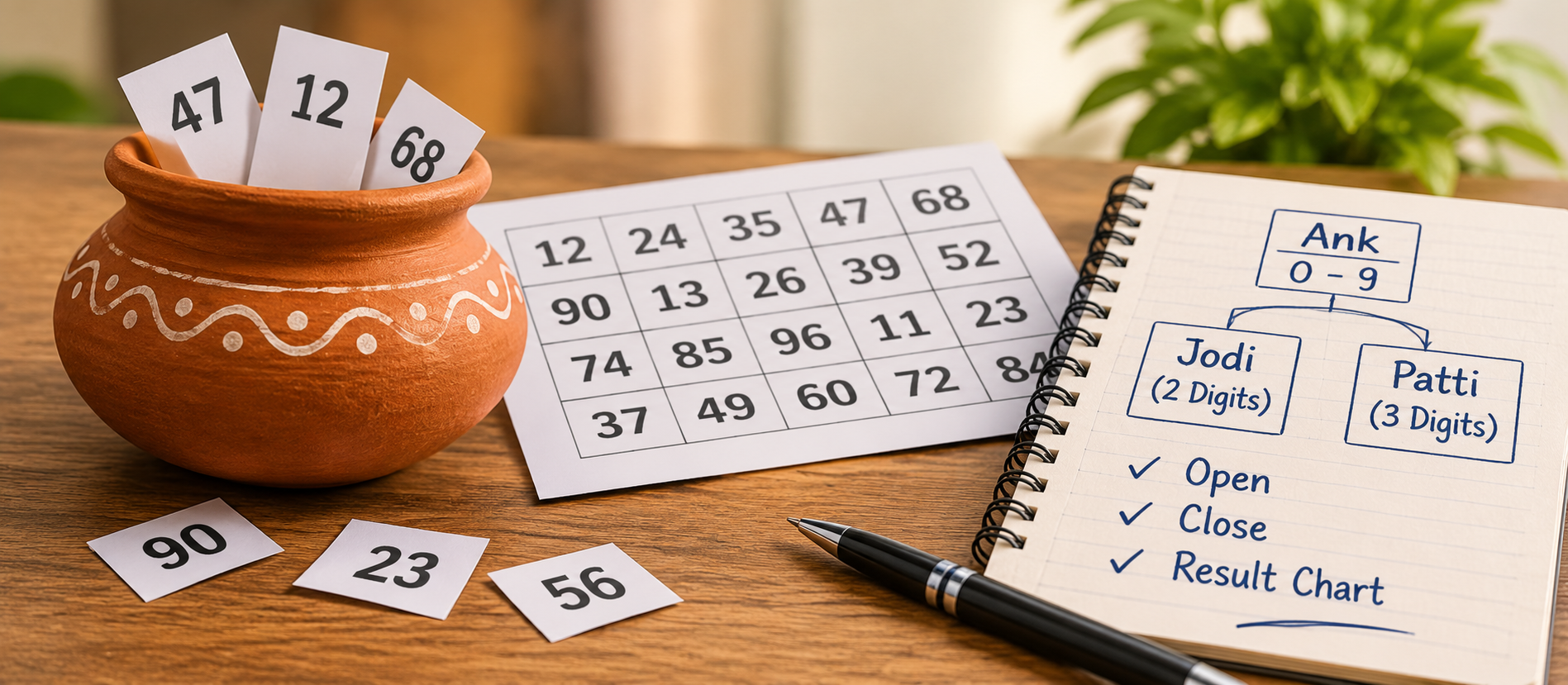
What Is the Difference Between Jodi, Patti, and Panna?
Jodi, Patti and Panna are three commonly used terms in traditional Satta Matka terminology, but each has a different meaning. Jodi refers to a two-digit combination, while Patti and Panna generally describe three-digit combinations. In this guide, we explain their meanings, key differences, and how these terms appear in historical Matka records in simple language.
By SattaResult · Published 18 Nov 2026, 5:54 pm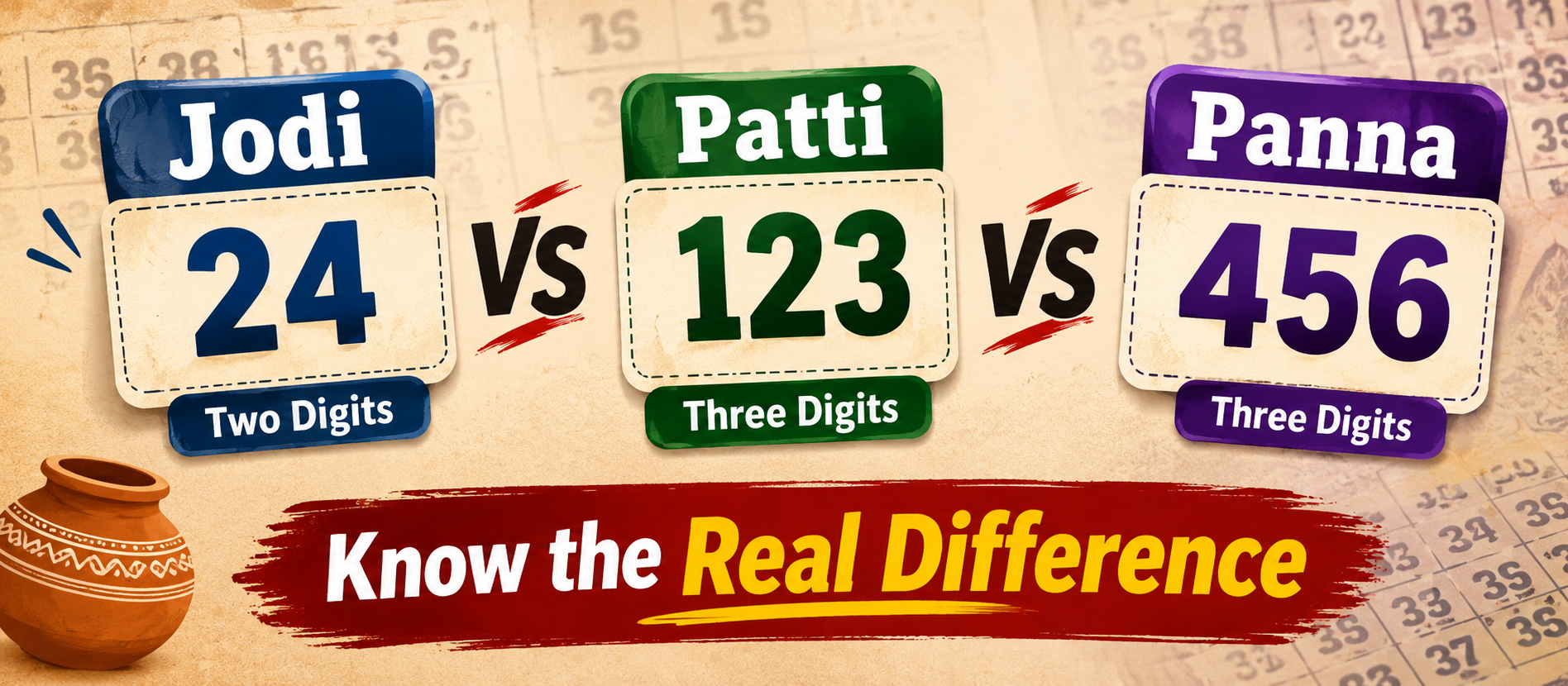
On this page
- What Is Jodi in Satta Matka?
- Key Characteristics of Jodi
- Why Does the Term Jodi Appear in Historical Matka Charts?
- What Is Patti in Satta Matka?
- Key Characteristics of Patti
- Why Is Patti Sometimes Confused with Panna?
- What Is Panna in Satta Matka?
- Key Characteristics of Panna
- Is Panna Different from Patti?
- Difference Between Jodi, Patti and Panna
- Jodi vs Patti
- Jodi vs Panna
- Patti vs Panna
- Understanding Other Common Satta Matka Terms
- 1. Ank
- 2. Single
- 3. Double
- 4. Triple
- 5. Open and Close
- How Are Jodi, Patti, and Panna Presented in Historical Records?
- Common Misunderstandings About Jodi, Patti and Panna
- Misunderstanding 1: Jodi and Panna Mean the Same Thing
- Misunderstanding 2: Patti and Panna Always Have Different Meanings
- Misunderstanding 3: Historical Number Records Can Predict Future Outcomes
- Misunderstanding 4: Every Website Uses Identical Terminology
- Can Historical Jodi, Patti and Panna Records Predict Future Results?
- Why Is It Important to Understand Traditional Matka Terminology?
- Legal and Financial Awareness
- Final Thoughts
- Frequently Asked Questions
- 1. What is the difference between Jodi, Patti and Panna?
- 2. Is Patti the same as Panna?
- 3. How many digits are there in a Jodi?
- 4. How many digits are there in a Panna?
- 5. What does Ank mean in Satta Matka?
- 6. Are Jodi and Patti interchangeable terms?
- 7. Are Jodi, Patti, and Panna used in historical Matka charts?
- 8. Can previous Jodi or Panna records predict future outcomes?
Satta Matka has its own traditional terminology, and three terms that frequently appear in discussions and historical records are Jodi, Patti, and Panna. For someone unfamiliar with this terminology, understanding the difference between these words can be confusing.
Although these terms are closely associated with the traditional Satta Matka number system, they do not mean the same thing. Jodi generally refers to a two-digit combination, while Patti and Panna refer to three-digit combinations. Each term describes a different numerical format found in traditional Matka records and charts.
Understanding the difference between Jodi, Patti, and Panna is useful for readers who want to understand historical Matka terminology, interpret older records, and become familiar with the language used in this subject.
In this guide, we explain what Jodi, Patti, and Panna mean, how they differ, what terminology is commonly associated with them, and why historical number records should not be treated as predictions of future outcomes.
What Is Jodi in Satta Matka?
In traditional Satta Matka terminology, Jodi refers to a two-digit number combination. It is commonly associated with the numerical labels used in historical result charts.
The word Jodi means a pair. In this context, it describes two digits presented together as one two-digit entry.
For example, 24, 38, 51, and 76 are examples of two-digit numerical formats. They illustrate the structure of a Jodi, rather than suggesting any particular result or outcome.
Jodi is one of the commonly encountered terms in traditional Matka records. Readers may see it mentioned alongside market names, historical result listings, and other number-related terminology.
Key Characteristics of Jodi
- Format: Two digits.
- Meaning: A numerical pair.
- Appearance: Commonly displayed as a two-digit entry in historical records.
- Terminology: Often discussed in connection with traditional Matka charts.
- Purpose in documentation: Identifies a particular two-digit numerical format.
Why Does the Term Jodi Appear in Historical Matka Charts?
Historical Matka charts often organise numerical information into different formats. Jodi is one of the labels used to describe two-digit entries.
For readers examining old records, recognising this term helps distinguish a two-digit entry from a three-digit Patti or Panna entry.
It is important to remember that a historical Jodi entry only documents a number recorded at a particular time. It does not establish what a future result will be.
What Is Patti in Satta Matka?
Patti is a traditional term used for a three-digit numerical combination in Satta Matka terminology.
Unlike Jodi, which contains two digits, Patti contains three digits. It is also commonly associated with the term Panna, and in many Matka contexts, both words are used to describe the same general three-digit format.
For example, 123, 248, 356, and 579 illustrate three-digit numerical combinations. These are examples of the format only, not predictions or recommended selections.
Patti is an important term to recognise when reading historical Matka-related material because it describes a different numerical structure from Jodi.
Key Characteristics of Patti
- Format: Three digits.
- Meaning: A three-digit numerical combination.
- Appearance: Usually represented as a three-digit entry.
- Related terminology: Panna.
- Purpose in documentation: Describes a three-digit numerical format in traditional records.
Why Is Patti Sometimes Confused with Panna?
One reason beginners find Matka terminology confusing is that Patti and Panna are often used interchangeably.
In common traditional usage, both terms refer to a three-digit combination. However, the terminology and classification can vary across different markets, websites, and historical records.
Therefore, readers should pay attention to the context in which a term appears instead of assuming that every source follows the same naming convention.
What Is Panna in Satta Matka?
Panna is another commonly used term for a three-digit numerical combination in traditional Satta Matka terminology.
It is closely related to Patti and is frequently used in discussions of historical number charts and Matka records.
For example, 145, 267, 348, and 579 are illustrations of three-digit number formats. They help explain what a Panna looks like as a numerical entry.
In many traditional contexts, Panna and Patti describe the same basic category. The difference is largely one of terminology and usage rather than the number of digits.
Key Characteristics of Panna
- Format: Three digits.
- Meaning: A three-digit numerical combination.
- Related term: Patti.
- Appearance: Commonly represented using three numerical digits.
- Context: Found in traditional Matka terminology and historical records.
Is Panna Different from Patti?
In general traditional usage, Panna and Patti are closely related terms and often refer to the same three-digit format.
However, some websites and market-specific sources may use these words differently when describing particular classifications.
For this reason, it is better to understand the general meaning of both terms while recognising that their usage is not necessarily identical across every source.
Difference Between Jodi, Patti and Panna
The main difference between Jodi, Patti and Panna is their numerical format and terminology.
Jodi refers to a two-digit pair, whereas Patti and Panna generally refer to three-digit combinations.
Here is a simple comparison:
Term | Numerical format | General meaning |
|---|---|---|
Jodi | Two digits | A numerical pair |
Patti | Three digits | A three-digit combination |
Panna | Three digits | Another term for a three-digit combination |
Jodi vs Patti
The primary distinction between Jodi and Patti is the number of digits.
Jodi consists of two digits, whereas Patti consists of three. They are therefore different numerical formats in traditional Matka terminology.
Jodi vs Panna
Jodi and Panna also differ in their numerical structure. Jodi describes a two-digit pair, while Panna generally refers to a three-digit combination.
Patti vs Panna
Patti and Panna are often used as alternative names for the same general three-digit format. Their exact usage can depend on the source or market terminology.
Understanding Other Common Satta Matka Terms
To understand Jodi, Patti, and Panna more clearly, it also helps to become familiar with a few related terms that frequently appear in traditional Matka discussions.
1. Ank
Ank is a Hindi-derived term meaning digit or number. In traditional Matka terminology, it is used to refer to a single-digit numerical value.
The term is frequently encountered in historical descriptions and number-related records.
2. Single
Single is a commonly used term for a one-digit numerical format.
It is useful to distinguish this terminology from Jodi, which describes a two-digit format.
3. Double
Double generally refers to a format in which the same digit appears twice, such as 11, 22, or 33.
It is a descriptive term for a repeated-digit numerical pair.
4. Triple
Triple commonly describes a format in which the same digit appears three times, such as 111, 222, or 333.
It is a descriptive numerical classification found in traditional terminology.
5. Open and Close
Open and Close are terms commonly encountered in traditional Matka records. They are used as labels for different parts of the recorded result format.
Their exact interpretation may vary according to the source and market.
How Are Jodi, Patti, and Panna Presented in Historical Records?
Historical Matka-related records may display different numerical formats together.
For example, a record may contain a two-digit entry alongside a three-digit entry. The terminology helps readers identify the format of each entry.
When examining such records, it is useful to understand the following distinctions:
- A two-digit entry is generally described as a Jodi.
- A three-digit entry may be described as Patti or Panna.
- A single-digit entry may be described as an Ank.
- Other labels may explain how a particular record is organised.
These descriptions help readers understand the vocabulary used in historical documentation.
However, the appearance of repeated numbers or numerical sequences in historical records should not be interpreted as evidence of a predictable pattern.
Common Misunderstandings About Jodi, Patti and Panna
People who are new to traditional Matka terminology often misunderstand these terms. Here are some common misconceptions.
Misunderstanding 1: Jodi and Panna Mean the Same Thing
They do not generally describe the same numerical format.
Jodi refers to two digits, while Panna refers to three digits.
Misunderstanding 2: Patti and Panna Always Have Different Meanings
In common usage, Patti and Panna frequently refer to the same three-digit format. Their terminology may differ between sources.
Misunderstanding 3: Historical Number Records Can Predict Future Outcomes
Historical records show information from the past. They do not provide a reliable method of determining future random outcomes.
A number appearing frequently in an old chart does not mean that it is more likely to appear again.
Misunderstanding 4: Every Website Uses Identical Terminology
Traditional terminology is not always standardised across websites and market-specific records.
Readers should consider the definitions and explanations provided by the particular source they are consulting.
Can Historical Jodi, Patti and Panna Records Predict Future Results?
No. Historical numerical records should not be treated as reliable predictions of future outcomes.
A common misunderstanding associated with number-based gambling is the belief that previous results can reveal what will happen next.
This is related to a cognitive bias known as the gambler's fallacy. It occurs when someone assumes that a previous outcome changes the probability of an independent future event.
For example, if a particular number has appeared several times in historical records, that fact alone does not establish that it is more or less likely to appear in the future.
Understanding this distinction is important when reading historical charts and numerical records.
Why Is It Important to Understand Traditional Matka Terminology?
Understanding terms such as Jodi, Patti, Panna, and Ank provides useful historical and linguistic context.
It helps readers:
- Recognise the numerical terminology used in traditional Matka records.
- Understand the difference between two-digit and three-digit formats.
- Interpret the vocabulary used in historical documents.
- Identify inconsistent terminology across different sources.
- Recognise why historical numerical information should not be treated as a prediction.
The goal of learning these definitions should be to understand the terminology and its context, not to rely on numerical combinations for financial decisions.
Legal and Financial Awareness
Satta Matka is associated with number-based gambling, which can involve substantial financial and personal risks.
The legal position of online money gaming in India has also changed. The Promotion and Regulation of Online Gaming Act, 2025 and its associated rules establish a regulatory framework that readers should understand before engaging with online gaming-related services.
Readers should consult the latest official legislation and government notifications rather than relying on informal websites for legal advice.
Useful official resources:
- India Code – Promotion and Regulation of Online Gaming Act, 2025
- Ministry of Electronics and Information Technology
It is also important to recognise the potential consequences of gambling-related financial losses, misleading predictions, and fraudulent websites.
Final Thoughts
Jodi, Patti, and Panna are three commonly encountered terms in traditional Satta Matka terminology, but they describe different numerical formats.
The simplest way to remember the distinction is that Jodi refers to two digits, while Patti and Panna generally refer to three digits. Although Patti and Panna are often used interchangeably, their usage can vary across different sources.
Understanding these definitions makes it easier to read historical Matka-related material and recognise the terminology used in older records. Most importantly, historical number information should be viewed as documentation of past events rather than a reliable way to predict future outcomes.
Frequently Asked Questions
1. What is the difference between Jodi, Patti and Panna?
Jodi generally refers to a two-digit numerical pair, whereas Patti and Panna commonly refer to three-digit numerical combinations. Patti and Panna are often used interchangeably in traditional Matka terminology.
2. Is Patti the same as Panna?
In common traditional usage, yes. Both terms generally describe a three-digit numerical format. However, terminology may vary between different sources.
3. How many digits are there in a Jodi?
A Jodi contains two digits. It is used as a descriptive term for a numerical pair in traditional Matka records.
4. How many digits are there in a Panna?
A Panna generally contains three digits. It is closely associated with the term Patti.
5. What does Ank mean in Satta Matka?
Ank is a term used to refer to a digit or single numerical value in traditional Matka terminology.
6. Are Jodi and Patti interchangeable terms?
No. Jodi generally refers to a two-digit format, while Patti describes a three-digit format.
7. Are Jodi, Patti, and Panna used in historical Matka charts?
Yes. These terms are commonly encountered in traditional Matka-related records and historical chart descriptions.
8. Can previous Jodi or Panna records predict future outcomes?
No. Historical records cannot reliably predict independent future outcomes. Past numerical appearances should not be treated as guaranteed indicators of future results.